
The short answer
What to know first.
The Maasai Mara and the Serengeti are one grassland ecosystem crossing the Kenya-Tanzania border, so the honest comparison is structural, not biological. The Serengeti is roughly ten times the Mara's size, organised into regions whose character changes with the rains, and demands more nights and usually internal flights to read properly. The Mara is compact and dense, reachable from Nairobi in a forty-five minute flight, and wrapped by private conservancies that permit what the reserve and the Tanzanian park do not: night drives, walking and off-road approaches. Migration season favours whichever side holds availability for your actual dates, since the herds answer to rain rather than to borders; the calving months belong to Tanzania's southern short grass; and the quiet months are superb in both, with the Mara's conservancies the strongest low-crowd play. Costs differ in shape rather than simply in size: the Mara's reserve charges 200 US dollars per person per day and its conservancies roughly 100 to 140 per night under current published schedules, while Tanzania's park and concession fees run to a similar order through TANAPA's published tariff. Sail operates partner camps on both sides and prices both from one desk, so the recommendation follows your dates, not our inventory.
At a glance
The planning brief.
One ecosystem
The Mara and the Serengeti are the same grassland crossing a border. The choice is structure and season, never a quality contest.
Scale versus concentration
The Serengeti is vast and regional; the Mara is compact and dense, with conservancies that change what a day may hold.
The season decides most files
Crossing months favour whichever side holds availability; the calving months belong to Tanzania's south; the Mara carries quiet months superbly.
Sail operates both
Partner camps on each side of the river system, priced from the same desk, so the recommendation follows the dates rather than the inventory.
01
One ecosystem, two structures
Strip the marketing away and the comparison becomes geography. The Serengeti-Mara ecosystem is a single sweep of grassland whose herds move in a rough annual circle; the border between Tanzania and Kenya crosses it, and the two countries organise their halves differently. Everything that genuinely distinguishes a Mara safari from a Serengeti safari flows from that organisation, not from the animals, which are the same populations moving across an invisible line.
Tanzania's half is a vast national park under TANAPA, read as regions: the southern short-grass plains, the central Seronera heartland, the western corridor toward the Grumeti, the northern Kogatende country on the Mara river. Kenya's half is a compact county-run reserve ringed by private conservancies, each a partnership between camps and Maasai landowners. Big journeys suit the first structure; short, dense journeys suit the second.
02
What each side does best
The Serengeti's gift is scale and self-sufficiency. A week inside one ecosystem, moving with the season from plain to river country, is a complete safari with no second destination required. Its regions reward specific months, its distances reward flying between airstrips, and its southern calving season, from roughly December to March on the Ndutu short grass, is a spectacle Kenya simply does not hold.
The Mara's gift is density and access. Nowhere in Africa serves a short safari better: forty-five minutes from Nairobi's Wilson airport to an airstrip, predators in famous concentration, and the conservancy system layered around the reserve. In the conservancies, vehicle numbers at sightings are capped, and walking, night drives and off-road approaches are permitted under each conservancy's rules, which changes what a single day can contain.
Choose the Serengeti when
You can give the safari six or more nights, want the journey to live inside one moving ecosystem, are targeting the calving months, or are building a Tanzania route with Ngorongoro and Tarangire.
Choose the Mara when
Nights are scarce, the file wants maximum wildlife per day, conservancy freedoms matter (walking, night drives, capped sightings), or the journey pairs with Kenya's Laikipia, Amboseli or coast.
Choose by availability when
Your dates sit inside the July-to-October crossing window: both sides serve it superbly, camps sell out far ahead, and the side that still holds space for your dates is usually the right side.
03
The migration months, honestly
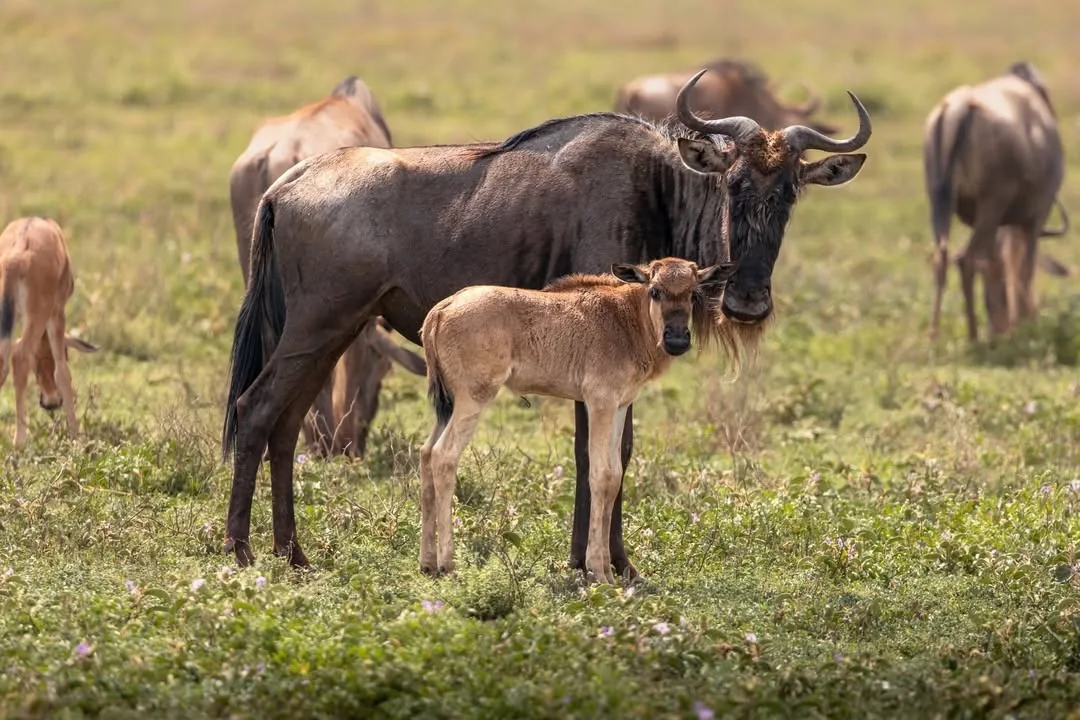
From roughly July to October the herds are in the north of the ecosystem, crossing and recrossing the Mara river on both sides of the border. Neither country owns the spectacle: the crossings happen in Tanzania's Kogatende country and in Kenya's Mara reserve, on no schedule any operator can promise. The mechanism is mass, water and hesitation on no timetable; the planning truth here is simpler.
In crossing season the deciding variables are availability and camp position, not nationality. The camps that sit well for the river book out furthest ahead on both sides, and a file that arrives late chooses whichever side still holds space. Outside those months the question dissolves: the calving belongs to Tanzania's south, and the green quiet months are excellent in both, with the Mara conservancies the strongest answer to crowds.
04
Cost shape, not cost winner
Neither side is reliably cheaper once like is compared with like; what differs is the shape of the fee layer. Kenya's Mara reserve charges 200 US dollars per person per day under Narok County's current schedule, while the conservancies charge roughly 100 to 140 US dollars per person per night, a fee that flows to member communities and funds the land itself. Tanzania charges through TANAPA's published VAT-inclusive tariff: in the Serengeti's case 82.60 US dollars per person per day of entry plus 70.80 per person per night of concession fee at current rates.
These figures are the authorities' to set, appear identically on every honest operator's quote, and are passed through at cost on Sail files, reconfirmed at booking. The real budget lever on both sides is the camp tier, which our two cost-anatomy pages set out band by band. From the Sail operations desk, checked August 2026: on identical tiers and dates, the two sides usually land within range of each other, and the choice deserves better reasons than a marginal arithmetic difference.
05
Getting there, and what it costs in time
The Mara is the easiest serious safari destination in Africa to reach: an international arrival into Nairobi, a light-aircraft hop from Wilson, and lunch at camp. That efficiency is why the Mara owns the short-safari market, and why a five-night Kenya file can hold both the Mara and a second region without strain.
The Serengeti asks more. Arrivals route through Kilimanjaro airport and Arusha, and the classic northern circuit approaches by road through Ngorongoro's highlands or by air to the park's strips. The overland approach is itself a journey worth designing, but the arithmetic is real: a Serengeti file spends more of its budget and calendar on positioning, which is why it rewards the longer stay once there.
06
How Sail actually advises
Because we contract camps on both sides, from Kaskaz in the Mara to our Serengeti partners across the regions, the desk has no inventory reason to steer you either way. The advisory sequence is the one this journal always uses: dates first, then live availability, then the honest matching of season to side, and only then the pleasant argument about camps.
The commonest outcomes are worth naming. First safaris with a week or more and an appetite for one deep immersion usually go Serengeti; first safaris built around scarce leave, families with mixed ages, or a wider Kenya route usually go Mara; and travellers torn in crossing season go where availability is real. All three outcomes are victories; the only defeat is choosing by brochure adjectives.
Questions travellers ask
Useful answers, before you decide.
Is the wildlife better in the Mara or the Serengeti?
It is the same ecosystem's wildlife under two management systems. Density per game-drive hour often feels higher in the compact Mara; range and variety of scene belong to the vast Serengeti. Neither side holds better animals.
Can one journey include both sides?
Yes, though the border crossing between them is a real logistics day and the pairing spends heavily on positioning. Our ten-nights-across-Kenya-and-Tanzania stress-test covers when the combination earns its cost.
Which side is better for a honeymoon?
The Mara's conservancies for privacy on a shorter file; the Serengeti for a longer, more immersive arc, especially with a Zanzibar chapter following. The honeymoon pages of this journal design both shapes.
Which side is cheaper?
On matched tiers and dates they usually land within range of each other; the fee structures differ more than the totals. The two cost-anatomy pages linked below carry the current planning bands.